
Decentralized infrastructure
How the Agoric Network works.
Agoric is a decentralized Proof-of-Stake network for JavaScript smart contracts and interchain applications. Explore validator consensus, BLD governance and the distinct role of the desktop wallet.
Explore the architecture
From desktop access to network execution
The desktop interface presents requests locally. Validators, smart contracts and interchain services handle authorized execution across the network.
Local interface
Desktop wallet
Presents account information and prepares requests for explicit authorization.
On-chain
Agoric network
Decentralized Proof-of-Stake Layer 1. Validators order, execute and finalize transactions.
On-chain
Smart contracts
JavaScript contracts and applications deployed on Agoric.
Across chains
Interchain services
Other chains reached through IBC and Orchestration-enabled applications.
Built for JavaScript
The Agoric network
Agoric is a decentralized Layer 1 blockchain for JavaScript smart contracts. Developers deploy applications that execute on a distributed validator network.
The contract framework applies research in distributed computing and object-capability security. Code operates within the capabilities explicitly granted to it.
Validator consensus
Cosmos and Proof-of-Stake
Agoric uses the Cosmos SDK and Proof-of-Stake consensus. Distributed validators, backed by delegated BLD, agree on transaction ordering and finalize blocks.
IBC connects Agoric with other independent chains in the Cosmos ecosystem.
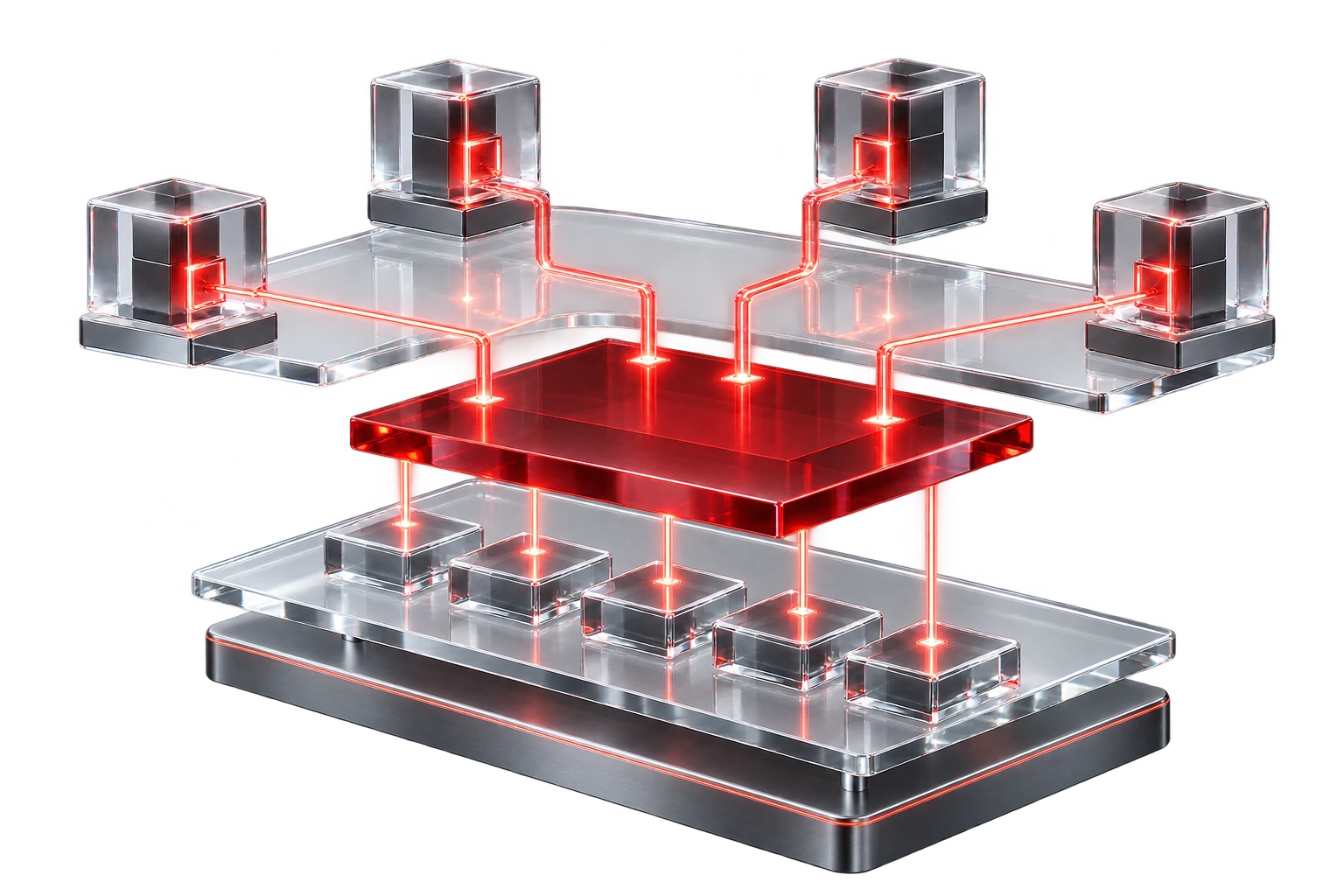
Transactions are submitted, validators agree on their order, blocks are finalized, and state updates become visible to wallets.
The native token
BLD staking and governance
BLD is the native token of the Agoric network. It is used to secure the chain through staking with validators and to participate in on-chain governance.
Delegated stake supports validator participation in consensus. On-chain governance enables BLD stakers to vote on network proposals.
Staking and governance operate at the network level. Access through a desktop interface depends on the functions supported by that application.

Connected chains
IBC interoperability
The Inter-Blockchain Communication protocol (IBC) enables independent chains to exchange verifiable messages and transfer assets without a central intermediary. Assets transferred to Agoric through this protocol are commonly described as IBC assets.
Interchain Orchestration
Agoric Orchestration enables smart contracts to coordinate actions across connected chains. A program can transfer an asset, execute an action on another chain and process the returned result.
Orchestration workflows are implemented by applications on Agoric. Their availability in a desktop interface depends on application integration.
Across blocks
Asynchronous and multi-block execution
Cross-chain execution can span multiple blocks as messages and responses travel between networks. Agoric JavaScript contracts use asynchronous programming to initiate a process, await remote results and continue execution when responses arrive.
Applications may display intermediate states while awaiting confirmation or remote results.
- N
- N+1
- N+2
- N+3
- N+4
Two distinct roles
Wallet and network responsibilities
| Responsibility | Agoric Wallet | Agoric Network |
|---|---|---|
| Information | Displays accounts, assets and activity | Holds the authoritative on-chain state |
| Requests | Presents requests for your review | Validates and orders transactions |
| Approval | Asks for your explicit approval | Executes only properly authorized transactions |
| Applications | Shows which apps are connected | Runs JavaScript smart contracts |
| Interchain | Displays assets that arrive via IBC | Connects to other chains over IBC |
| Security | Presents details for informed authorization | Secured by BLD-staked validators |
Network capabilities described here belong to the decentralized Agoric chain. Desktop functions depend on the application. Explore the ecosystem or the wallet tour.